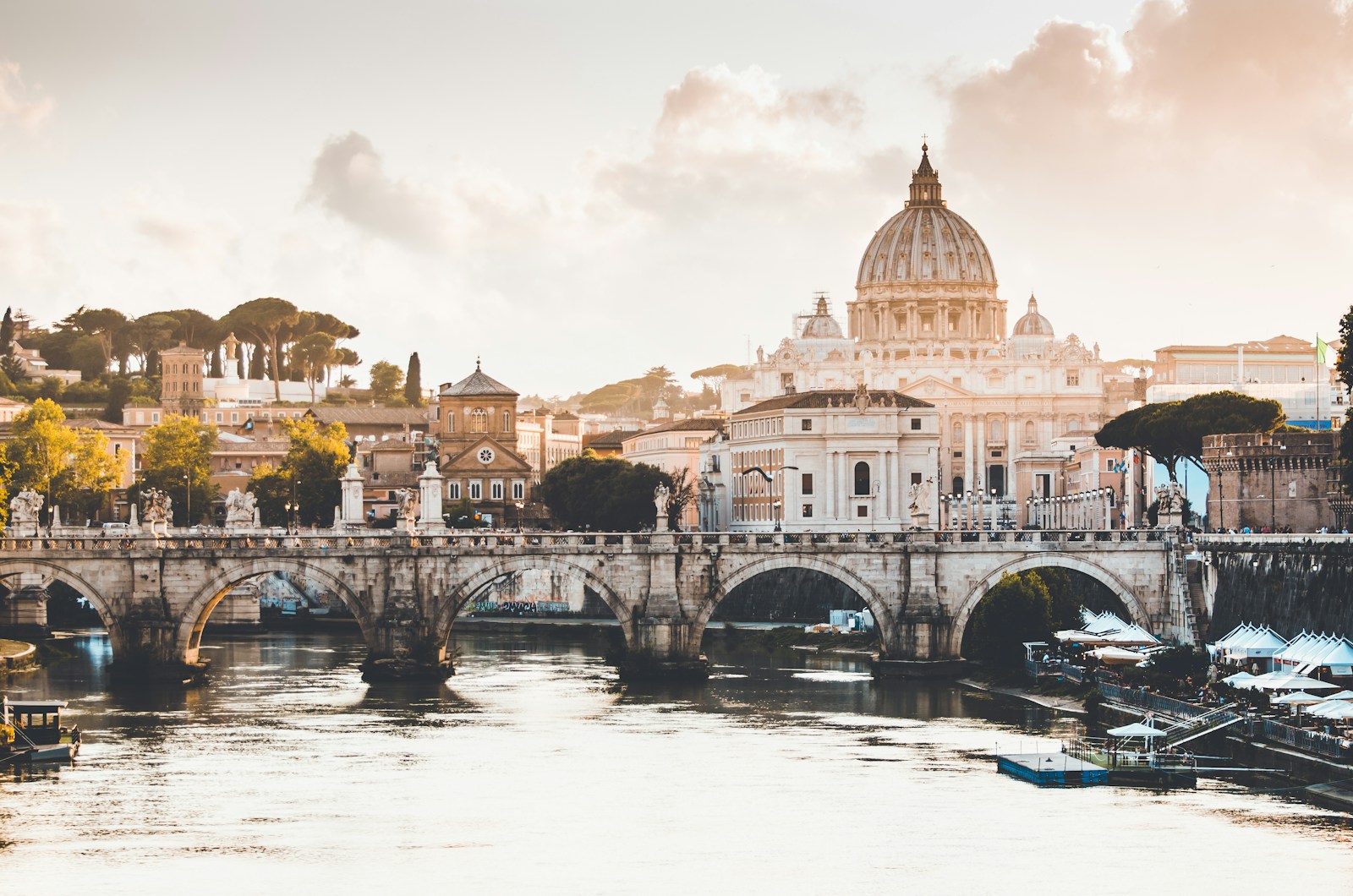
3 Days in Rome
Three days is enough to see Rome properly — the ancient sites, the Vatican, the Borghese, and the Rome that tourists miss.
Three days is the sweet spot for Rome. You can cover the main sites without rushing, explore a neighbourhood or two, eat three or four excellent meals, and still have time to sit in a piazza with a Negroni and do nothing. Here's how to use them.
Day 1: Colosseum + Roman Forum (coopculture.it or GetYourGuide) — 1 week ahead minimum.
Day 2: Vatican Museums (museivaticani.va or GetYourGuide) — 2–3 weeks ahead in summer.
Day 3: Borghese Gallery (galleriaborghese.it) — must be booked, no walk-ins. 2-hour timed slots. Book 2+ weeks ahead. This is the most overlooked booking requirement in Rome.
Day 1: Ancient Rome
7:00am — Testaccio Market
The best market in Rome opens at 7am. Via Galvani, Testaccio. Go early for the best produce and fewer people. Street food stalls open from around 8am — supplì (fried risotto balls), pizza al taglio, fresh-squeezed juice. The market runs Tuesday to Saturday. If you're visiting on a Monday or Sunday, skip this and start at 8:30am with the Trevi Fountain.
8:30am — Trevi Fountain (if not Monday/Sunday morning start)
See the 1-day itinerary for the logic here. Early morning, before 9am, is the only sensible time.
9:00am — The Pantheon
Book ahead (€5, pantheonroma.com). Opens 9am; arrive at opening for the shortest queue. One hour inside is enough; the architecture and tombs reward attention but not more than an hour.
10:30am — Colosseum, Roman Forum, Palatine Hill (3.5 hrs)
With three days, you can afford to go slower here. The combined ticket is valid across two consecutive days for the Forum and Palatine — use this. Today: Colosseum interior, with the underground hypogeum (book as an add-on) and the upper tiers for Forum views. Save the Forum itself for a quieter late-afternoon visit tomorrow if you want more time.
Book Colosseum Skip-the-Line
The Colosseum without pre-booked tickets means a 2-hour queue. Book online before you travel.
2:00pm — Lunch and Testaccio Exploration
Head to Testaccio for lunch — one of the most authentic food neighbourhoods in Rome. Flavio al Velavevodetto (Via di Monte Testaccio 97) for proper Roman cuisine. After lunch: the Testaccio neighbourhood itself is worth a walk — the old slaughterhouse (Mattatoio di Roma) is now a contemporary arts centre with free exhibitions. Monte Testaccio — literally a hill made entirely of broken Roman amphora shards, 50 metres high — is visible from the street.
4:00pm — Aventine Hill and Orange Garden
Walk up the Aventine Hill. The Orange Garden (Giardino degli Aranci) has one of the best free views in Rome. Then the Knights of Malta keyhole on Piazza dei Cavalieri di Malta — the framed view of St Peter's dome. Quiet, beautiful, almost no tourists.
6:30pm — Monti Aperitivo
Take bus 23 or walk 25 minutes to Monti. Via dei Serpenti has excellent aperitivo bars — Il Sorpasso-equivalent quality but smaller and more intimate. Vino e Camino or Al Tre Scalini for wine and aperitivo food.
8:30pm — Dinner in Monti
La Barrique (Via del Boschetto 41b) for natural wine and excellent Roman cooking. Or: Osteria dell'Angolo in Prati if you're considering day 2's Vatican proximity.
Day 2: Vatican and Beyond
8:30am — Vatican Museums at Opening (3–4 hrs)
Your pre-booked skip-the-line ticket. Enter at 9am. The route: Pinecone Courtyard → Gallery of Maps → Raphael Rooms → Sistine Chapel. The Gallery of Maps alone is worth 20 minutes — 40 enormous maps of Italian regions painted on the walls in the 1580s, some showing towns that no longer exist, others showing coastlines that haven't changed. The Raphael Rooms: the School of Athens, the Liberation of St Peter. The Sistine Chapel: the ceiling (1508–1512), the Last Judgment (1534–1541). Go slowly.
Book Vatican Skip-the-Line
2–3 weeks ahead in summer. The Vatican Museums queue without a ticket is 2–3 hours. Don't try to walk in.
12:30pm — St Peter's Basilica and Dome (2 hrs)
Free entry (separate queue from Vatican Museums, no booking needed). The Pietà. Bernini's baldachin. Then the dome climb — €8 for stairs, €10 for the lift to halfway. The view from the dome is the best in Rome. The lantern at the top of the dome: 136 metres above ground.
3:00pm — Castel Sant'Angelo (1.5 hrs)
Walk along the Tiber to Castel Sant'Angelo — the former mausoleum of Hadrian, converted into a castle, connected to the Vatican by the Passetto (the elevated covered corridor visible from outside). The castle has dungeons, cannon emplacements, a drawbridge, and panoramic views. The sunset from the ramparts is extraordinary. Ticket €14.
6:00pm — Pigneto for Aperitivo
This is the local's evening. Take tram 8 from Largo Argentina or bus towards Porta Maggiore to reach Pigneto (20–25 minutes). Via del Pigneto pedestrian street is the centre. Pigneto Ferracci is the classic bar. Aperitivo here looks nothing like the tourist version: it's locals after work, drinking wine or beer, eating from the bar spread, talking loudly. Excellent and cheap (€5–7 a drink).
8:30pm — Dinner in Pigneto
Necci dal 1924 (Via Fanfulla da Lodi 68) — a historic bar and restaurant that was a favourite of Pier Paolo Pasolini, who lived nearby. Good food, excellent atmosphere, very Roman. Or several other excellent options on the surrounding streets.
Day 3: The Other Rome
9:00am — Borghese Gallery (2 hrs, timed entry)
Your pre-booked 2-hour timed entry. The Borghese Gallery is the most intense art-per-square-metre experience in Rome. Bernini's sculptures in particular: Apollo and Daphne (Daphne's fingers becoming laurel leaves as she transforms, Bernini aged 24 when he started it), The Rape of Proserpina (Pluto's fingers pressing into Proserpina's thigh — the marble looks like flesh), David (Bernini used his own face). Also: Titian, Raphael, Caravaggio. You have exactly 2 hours. Use them. You will need the full 2 hours.
Book Borghese Gallery Now
No walk-ins. Timed entry only. Book 2+ weeks ahead — it sells out in peak season. This is the most important booking in Rome that people forget.
11:00am — Villa Borghese Park (1 hr)
The park surrounding the Borghese Gallery is 80 hectares of formal gardens, wooded paths, a lake, bike hire. After the intensity of the gallery, the park is the perfect decompression. Walk to the Pincio Terrace (north edge of the park) for the great free panoramic view over Piazza del Popolo and the city. Have a coffee at the café on the terrace.
12:30pm — Piazza del Popolo (30 mins)
Walk down from the Pincio to the piazza below. The twin churches (Santa Maria in Montesanto and Santa Maria dei Miracoli, built to look identical but aren't — one is oval inside, one circular), the 3,200-year-old obelisk, the gate that was Rome's entrance from the north for centuries. Free. Usually manageable crowds.
1:30pm — Lunch in the Flaminio Area
The Flaminio neighbourhood north of Piazza del Popolo has good local restaurants. Il Sorpasso (Via Properzio 31, Prati — 15-minute walk) is one of Rome's best lunch and aperitivo bars with an excellent food spread. Or cross the Tiber into Prati for any trattoria on Via dei Gracchi.
3:30pm — Monti Neighbourhood Afternoon
Your third afternoon in Rome and you now have the pace for it. Monti is best explored slowly. The Basilica of Santa Maria Maggiore (free, one of Rome's four papal basilicas, extraordinary 5th-century mosaics). The surrounding streets: vintage shops, bookshops, wine bars, the occasional artisan workshop still operating.
5:00pm — Optional: Roman Forum and Palatine Hill Return
If you used only part of your combined Colosseum ticket on Day 1, the Forum and Palatine Hill are included. Late afternoon is the best time — the crowds thin after 4pm and the light on the ruins is extraordinary.
7:00pm — Final Aperitivo
Back in Trastevere or wherever felt most like Rome to you. Freni e Frizioni, Bar San Calisto, or just find a bar on a piazza with outdoor seating. Order a Negroni. Sit with it for an hour.
9:00pm — Final Dinner
Make it count. Roscioli (Via dei Giubbonari 21, book 2 weeks ahead) for the carbonara. Or Da Enzo al 29 if you haven't been. Or Osteria Fernanda for something more refined. Or just ask whoever you're staying with where they would go.
What 3 Days Lets You Do That 2 Days Doesn't
- The Borghese Gallery — genuinely not possible to add to a 2-day itinerary without sacrificing something significant
- Pigneto and Testaccio — the neighbourhoods where Romans actually live and eat, inaccessible if you're only hitting the tourist circuit
- The Testaccio market — requires an early morning that 2-day itineraries don't have space for
- Going slowly in the Sistine Chapel rather than being shuffled through
- A real Sunday lunch — 3 hours at a table, multiple courses, no rush
- The minor sites that make Rome extraordinary: the Aventine keyhole, the Orange Garden, the Theatre of Marcellus at night
Take the 30-minute train to Ostia Antica — Rome's ancient port city, almost nobody there, extraordinary ruins. Or the 1hr 15min train to Orvieto — the most dramatic hilltop town in Italy with one of the finest Gothic cathedrals in Europe. Either is one of the best day trips in Italy.